

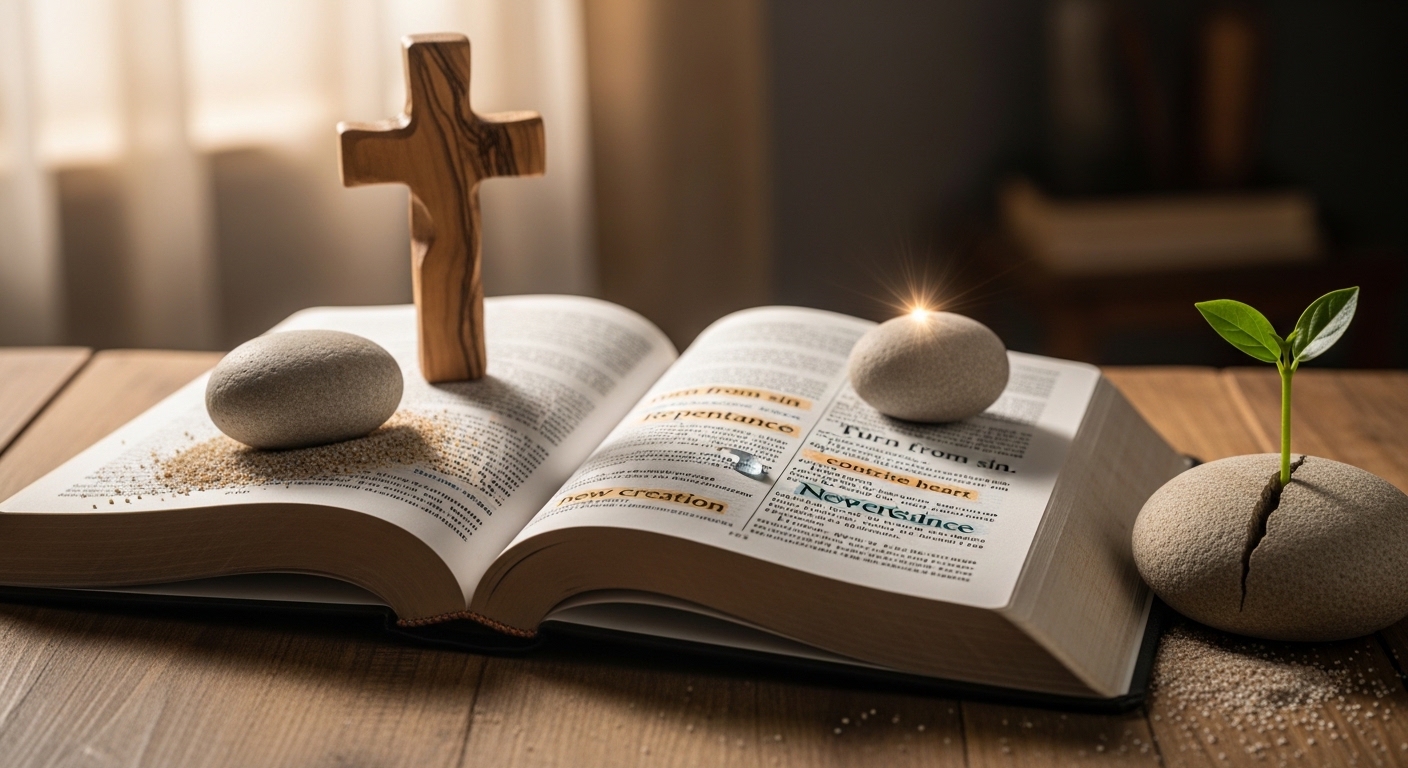
You have probably said “I’m sorry” before. Maybe you meant it. Maybe you just wanted to move past the fight. Guilt feels heavy. Regret stings. But the Bible talks about something much deeper than a simple apology. It calls this true repentance.
Many people confuse feeling bad with real change. You can cry over a mistake and still make it again the next day. That is not repentance. That is just emotional pain. True repentance touches your heart first. Then it changes your actions. It leads to a completely different life.
In this guide, you will learn the clear meaning of repentance from the Bible. You will see the step-by-step process for genuine change. You will also discover the signs of a heart that has truly turned around. If you have ever wondered, “Did I really repent?” or “How do I know my sorrow is real?” this article will give you honest answers.
What Is True Repentance in the Bible?
True repentance in the Bible is not a feeling. It is a complete change of mind that leads to a change of action. You stop going your own way. You turn around. You start going God’s way instead.
Think of a person driving west. They realize they should drive east. Repentance is not just feeling bad about going west. It is grabbing the wheel, turning the car, and heading east. The direction changes fully.
Meaning of “Repentance” (Greek: Metanoia)
The New Testament uses the Greek word metanoia for repentance. Meta means “after” or “change.” Noia comes from nous, which means “mind.” So metanoia literally means a “change of mind.”
But this is not a small change. You do not just change your opinion about a movie or a food. You change your entire way of thinking about sin, God, and yourself. Before repentance, you saw sin as fun or harmless. After repentance, you see sin as destructive and wrong. Before, you saw God as a killjoy. After, you see Him as good and worthy of your obedience.
This change of mind then changes your behavior. You do not just think differently. You live differently.
Difference Between Regret and Repentance
Regret and repentance look similar on the outside. Both involve tears. Both involve saying “I’m sorry.” But the outcomes are totally different.
Regret focuses on the consequences. You feel bad you got caught. You feel bad you lost something. You feel bad you hurt your own life. Regret says, “I hate that I have to pay for this.”
Repentance focuses on the sin itself. You feel bad you offended God. You feel bad you hurt others. You feel bad you broke a holy standard. Repentance says, “I hate that I did this wrong thing.”
The Bible gives a clear example of this difference. Judas betrayed Jesus. He felt remorse. He threw the money back. He said he sinned. Then he went and killed himself (Matthew 27:3-5). Judas had regret. He did not have true repentance. Peter denied Jesus three times. He wept bitterly. But he turned back to Jesus. He became a leader in the early church. Peter had true repentance.
Regret stays stuck in guilt. Repentance moves toward restoration.
Why Repentance Is Central to the Gospel
Repentance is not an extra step for super-religious people. It is the front door of the Christian faith. When John the Baptist prepared the way for Jesus, he shouted, “Repent, for the kingdom of heaven has come near” (Matthew 3:2). Jesus Himself started His ministry with the same words: “Repent, for the kingdom of heaven has come near” (Matthew 4:17).
After Jesus rose from the dead, He told His followers to preach repentance and forgiveness of sins to all nations (Luke 24:47). On the day of Pentecost, Peter told the crowd to repent and be baptized (Acts 2:38).
You cannot follow Jesus without turning from your old way of life. The gospel is not just “believe in Jesus.” It is “repent and believe.” The two go together like two wings on a plane. You need both to fly.
What Does the Bible Say About Repentance?
The Bible talks about repentance from the first pages to the last. God constantly calls His people to come back to Him. The words change between the Old and New Testaments, but the message stays the same: turn away from sin and turn back to God.
Key Old Testament Foundations (Shuv – Turning Back)
The main Hebrew word for repentance in the Old Testament is shuv. It means “to turn back” or “to return.” Imagine a person walking away from their home. Shuv means to turn around and go back home.
God sent prophet after prophet to Israel. He begged them to shuv. He did not just want them to feel sad about their idols. He wanted them to smash the idols and come back to worship Him alone.
In Ezekiel 18:30-32, God says, “Repent! Turn away from all your offenses… Get a new heart and a new spirit.” Notice the action words. Turn away. Get a new heart. This is not passive sorrow. This is active change.
The Old Testament shows that true repentance always involves action. The king of Nineveh did not just tell his people to feel bad. He told them to stop their evil ways and violence (Jonah 3:8-10). God saw their actions. And He showed mercy.
Repentance in the Teachings of Jesus
Jesus taught more about repentance than most people realize. He told parables about it. He commanded it. He also warned against false repentance.
In the parable of the prodigal son, the younger son demanded his inheritance early. He wasted it on wild living. Then a famine hit. He ended up eating pig food. That is when he came to his senses. He said, “I will set out and go back to my father” (Luke 15:18). He did not just sit in the pig pen feeling sorry. He got up. He went home. He confessed. That is true repentance.
Jesus also warned religious leaders who looked holy on the outside but stayed corrupt on the inside. He called them whitewashed tombs (Matthew 23:27). They cleaned up their appearance but never changed their hearts. That is false repentance.
One of the most powerful examples is Zacchaeus. He was a cheating tax collector. He met Jesus. Then he said, “Look, Lord! Half of my possessions I give to the poor. And if I have cheated anybody, I will pay back four times the amount” (Luke 19:8). Jesus did not demand this. The changed heart produced changed actions. That is the fruit of true repentance.
Repentance in the Early Church (Acts)
The book of Acts shows repentance in action. After Peter’s sermon at Pentecost, three thousand people repented, got baptized, and changed their lives. They sold possessions. They shared with the poor. They devoted themselves to teaching and prayer (Acts 2:41-47).
Later, Simon the sorcerer believed and got baptized. But he tried to buy the power of the Holy Spirit with money. Peter rebuked him sharply: “Repent of this wickedness and pray to the Lord” (Acts 8:22). Simon had believed, but he still had a corrupt heart. He needed to repent again.
The early church treated repentance as a normal part of following Jesus. New believers turned from idols. They turned from sexual sin. They turned from greed. And they turned to the living God.
The Step-by-Step Process of True Repentance
True repentance follows a clear pattern in the Bible. It is not random or mysterious. You can walk through these steps when you realize you have sinned. Each step builds on the one before it.
1. Conviction of Sin (Awareness)
You cannot repent of sin you do not see. The first step is conviction. Conviction is the Holy Spirit opening your eyes to something wrong in your life.
Conviction feels uncomfortable. Your conscience bothers you. A Bible verse keeps coming to your mind. A sermon hits too close to home. You feel a weight you cannot shake.
The Holy Spirit does this work. Jesus said the Spirit would convict the world concerning sin and righteousness and judgment (John 16:8). Conviction is a gift. It is God’s mercy waking you up before you go further down a bad road.
Do not run from conviction. Lean into it. Ask God, “What are You showing me?”
2. Godly Sorrow (Heart Response)
Not all sorrow leads to life. Paul made this clear in 2 Corinthians 7:10. He wrote, “Godly sorrow brings repentance that leads to salvation without regret. But worldly sorrow brings death.”
Godly sorrow is sad for the right reasons. You are sad because you dishonored God. You are sad because you hurt someone made in His image. You are sad because you love God and you failed to obey Him.
Worldly sorrow is sad for selfish reasons. You are sad you might get punished. You are sad you lost your reputation. You are sad your life got harder. This sorrow does not produce real change. It just produces self-pity.
Check your heart when you feel sorry for sin. Are you crying over the sin itself or over the consequences?
3. Confession (Acknowledging Sin)
Confession means agreeing with God about your sin. You stop making excuses. You stop blaming others. You stop minimizing what you did. You say, “God, You are right. I am wrong. This thing I did was sin.”
First John 1:9 gives a wonderful promise: “If we confess our sins, He is faithful and just to forgive us our sins and to cleanse us from all unrighteousness.”
Confession is not telling God something He does not already know. He knows everything. Confession is you admitting the truth so you can receive His forgiveness.
Be specific in confession. Do not just say, “Forgive my sins.” Name the sin. “Forgive me for lying to my coworker.” “Forgive me for looking at pornography.” “Forgive me for losing my temper with my kids.” Specific confession leads to specific cleansing.
4. Turning Away (Action)
Here is where repentance gets real. Turning away means you stop doing the sin. You remove yourself from the situation. You block the website. You end the relationship that pulls you down. You walk away from the argument.
The Old Testament prophets called this “forsaking” sin. Isaiah 55:7 says, “Let the wicked forsake their ways and the unrighteous their thoughts.” Forsake means to leave behind completely.
Turning away is an act of your will. You choose to obey God even when you do not feel like it. You choose to do the hard thing. Over time, the feelings catch up to the choices. But it starts with a decision.
5. Transformation (New Life)
The final step is the proof of repentance. You do not just stop the bad behavior. You start good behavior. You fill the empty space with righteousness.
Jesus told a story about a demon leaving a person. The house was swept clean but empty. The demon came back with seven worse demons and moved back in (Matthew 12:43-45). Stopping sin without starting righteousness leaves you vulnerable.
True transformation means you now walk in obedience. You read your Bible. You pray. You serve others. You give generously. You speak kindly. The old things pass away. New things come (2 Corinthians 5:17).
This transformation is not instant perfection. It is a new direction. You still stumble. But you get back up. You keep turning toward God.
True Repentance vs False Repentance
Not every apology is real. Not every tear is genuine. The Bible warns us to examine ourselves. We must know the difference between true repentance and a cheap imitation.
Signs of False Repentance
False repentance looks religious but lacks real change. Watch for these warning signs.
Fear-based regret. A person fears punishment more than they hate sin. They change their behavior only long enough to escape consequences. Once the danger passes, they return to the sin.
Temporary change. False repentance produces short-term results. A person might stop drinking for a week. They might stop yelling for a day. But they never deal with the root issue. Soon enough, the old patterns return.
Justification of sin. A person who truly repents takes full responsibility. A person with false repentance makes excuses. “Yes, I lied, but you made me angry.” “Yes, I cheated, but everyone does it.” They shift blame instead of owning their sin.
Minimizing the offense. “It was not that big of a deal.” “God understands.” These phrases often hide an unrepentant heart. True repentance calls sin what God calls it. False repentance renames sin as a mistake, a habit, or a personality flaw.
Signs of True Repentance
True repentance leaves clear evidence. You can see it in a person’s life over time.
Lasting transformation. The change sticks. A truly repentant person may struggle. They may even fall back into sin temporarily. But they do not stay there. They get back up. And over the long haul, their life looks different.
Desire for righteousness. A changed heart does not just hate sin. It loves holiness. The repentant person starts to enjoy prayer. They find joy in Scripture. They want to please God, not just avoid hell.
Humility before God. True repentance breaks pride. You stop defending yourself. You stop comparing yourself to others. You simply bow low and say, “God, be merciful to me, a sinner.” Humility welcomes correction. It thanks the person who points out sin.
Restitution where possible. Like Zacchaeus, a truly repentant person tries to make things right. They pay back what they stole. They apologize to the person they slandered. They repair relationships.
Open confession. False repentance hides. True repentance comes into the light. The person willingly admits their sin to trusted believers. They ask for prayer. They invite accountability.
Signs of Genuine Repentance (Biblical Evidence)
The Bible gives clear tests to know if repentance is real. You do not have to guess. These signs act like a spiritual health checklist.
Producing Fruit (Matthew 3:8)
John the Baptist told the religious leaders to “produce fruit in keeping with repentance.” Fruit is the visible proof of an invisible change.
Think of an apple tree. You do not argue with it to produce apples. You do not force apples onto its branches. If the tree is healthy and alive, apples come naturally. In the same way, a truly repentant person naturally produces good works. They help the poor. They speak the truth. They control their temper.
The fruit takes time to grow. A newly repentant person will not have perfect fruit overnight. But you should see progress. You should see direction. You should see a pattern of goodness increasing over time.
Changed Behavior and Mindset
First John 3:9 says, “No one who is born of God will continue to sin.” This verse does not mean a Christian never sins again. It means a Christian does not keep sinning as a lifestyle.
A changed person thinks differently about their sin. They used to plan it. Now they fight it. They used to defend it. Now they confess it. They used to hide it. Now they expose it to the light.
This change shows up in small ways and big ways. A gossiper starts speaking well of others. A greedy person starts giving generously. A proud person starts serving humbly.
Desire for Obedience
Jesus said, “If you love Me, keep My commandments” (John 14:15). True repentance produces a desire to obey. You do not obey to earn God’s love. You obey because you already have it.
The repentant person reads God’s commands and says, “I want to do that.” They see a command to forgive and they want to forgive. They see a command to be sexually pure and they want to be pure. The law is no longer a burden. It is a delight.
This does not mean obedience is easy. The flesh still fights. The world still tempts. But the heart’s deepest desire has changed. You want what God wants.
Why Repentance Matters for Salvation
Some people teach that repentance is optional. They say you only need to believe. But the Bible ties repentance and faith together from beginning to end. You cannot separate them.
Relationship Between Faith and Repentance
Think of faith and repentance as two sides of the same coin. One side is turning to Christ. The other side is turning from sin. You cannot do one without the other.
When you truly believe in Jesus, you trust Him as Lord and Savior. Lord means master. You cannot call Jesus Lord while continuing to rebel against His commands. Faith itself includes a change of loyalty.
Hebrews 6:1 calls repentance and faith “elementary teachings” of the Christian faith. They are the foundation. You cannot build a house without a foundation. You cannot be a Christian without repentance and faith.
Is Repentance Required for Salvation?
Yes, Scripture clearly requires repentance for salvation. Jesus said, “Unless you repent, you too will all perish” (Luke 13:3). Peter said, “Repent and be baptized, every one of you, in the name of Jesus Christ for the forgiveness of your sins” (Acts 2:38). Paul told the Athenians that God “commands all people everywhere to repent” (Acts 17:30).
Repentance does not save you by itself. Only the blood of Jesus saves. But repentance is the way you receive that salvation. It is the empty hand that takes the gift.
Imagine a drowning person. A rescuer throws a rope. The drowning person must grab the rope to be saved. Grabbing the rope does not save them. The rescuer saves them. But they still have to grab it. Repentance is grabbing the rope. Faith is trusting the rescuer. Both are necessary.
God’s Mercy and Patience (2 Peter 3:9)
Some people wonder why God does not judge sinners immediately. Why does He let evil continue? Second Peter 3:9 answers: “The Lord is not slow in keeping His promise… Instead, He is patient with you, not wanting anyone to perish, but everyone to come to repentance.”
God delays judgment out of mercy. He gives people time to turn. Every day you wake up breathing is another day of God’s patience. He wants you to repent. He is not angry and waiting to punish. He is loving and waiting to forgive.
But His patience has a limit. Death comes. Jesus returns. The offer of repentance will not last forever. Today is the day to turn.
Common Misunderstandings About Repentance
Many people carry wrong ideas about repentance. These misunderstandings keep them stuck in guilt or false security. Let us clear up three common ones.
“Repentance Is Just Feeling Sorry”
You already learned the difference between regret and repentance. But this misunderstanding is so common it deserves repeating. Feeling sorry is not enough. The Bible never says, “Feel sad and you will be saved.” It says repent.
Cain felt sorry after killing Abel. He said his punishment was too great to bear. But he never truly turned back to God. Esau wept bitterly after losing his blessing. But Hebrews 12:17 says he found no place for repentance, though he sought it with tears.
Tears can be real. Sorrow can be deep. But without a turn toward God, those tears are just emotional pain. True repentance always includes action.
“I Can Repent Later Anytime”
This is a dangerous game people play with their souls. They plan to keep sinning now. They tell themselves, “I will repent later.” But no one is guaranteed later.
The Bible warns, “Do not boast about tomorrow, for you do not know what a day may bring” (Proverbs 27:1). James 4:14 says your life is a mist that appears for a little while and then vanishes.
The longer you delay repentance, the harder your heart becomes. Sin hardens like cement. Fresh cement is soft. You can leave a mark. But over time, it hardens. Nothing can change it. A heart that sins today and says “I will repent tomorrow” is hardening today.
Repent today. Right now. Do not gamble with your soul.
“Repentance Means Perfection”
Some people never feel like they have truly repented because they still struggle with sin. They think true repentance would make them perfect. This is not biblical.
Repentance is a complete change of direction, not a complete change of perfection. A man driving east toward New York may still drift toward the shoulder. He may need constant small corrections. But he is still heading east. He is not driving west anymore.
You will struggle with sin until you die or Jesus returns. That struggle does not mean your repentance was fake. It means you live in a fallen body in a fallen world. The difference is your heart now hates the struggle. You fight it. You confess it. You get back up.
How to Practice True Repentance Today
Repentance is not a one-time event. It is a daily rhythm for the Christian life. You turn from sin. You turn to God. You do it again tomorrow. Here is how to build this rhythm.
Daily Self-Examination
Set aside time each day to look at your heart. The Bible says, “Examine yourselves to see whether you are in the faith” (2 Corinthians 13:5). This is not about obsessing over every tiny failure. It is about staying humble and honest.
Ask yourself three questions each night:
- Where did I disobey God today?
- Where did I love something more than God?
- Who did I hurt with my words or actions?
When you find sin, do not let it sit. Confess it immediately. Turn away from it before you sleep. Do not carry yesterday’s sin into tomorrow.
Prayer and Accountability
You cannot repent alone. You need God’s help. Pray daily, “Search me, God, and know my heart. See if there is any offensive way in me” (Psalm 139:23-24). Ask the Holy Spirit to show you hidden sin. Ask for strength to turn.
You also need other believers. James 5:16 says, “Confess your sins to each other and pray for each other so that you may be healed.” Find a mature Christian you trust. Meet with them regularly. Tell them your struggles. Let them ask you hard questions. Do not hide.
Accountability is not about shame. It is about love. A true friend helps you see your blind spots. They cheer for your repentance. They pray for your success.
Renewing the Mind Through Scripture
Repentance starts with a changed mind. The mind changes through the Word of God. Romans 12:2 says, “Be transformed by the renewing of your mind.”
Read your Bible every day. Let it correct your thinking. You believe lies about sin. The Bible tells the truth. You believe sin will satisfy you. The Bible shows the emptiness. You believe God is holding out on you. The Bible reveals His goodness.
Memorize verses about repentance and holiness. Write them on index cards. Put them on your mirror. When temptation comes, fight back with Scripture. Jesus defeated Satan in the wilderness by quoting Deuteronomy. You can do the same.
Powerful Bible Verses About Repentance
God’s Word is alive and active. These verses will help you understand repentance more deeply. Let them speak to your heart.
Key New Testament Verses
- Matthew 4:17 – From that time on Jesus began to preach, “Repent, for the kingdom of heaven has come near.”
- Luke 15:10 – “There is rejoicing in the presence of the angels of God over one sinner who repents.”
- Acts 3:19 – “Repent, then, and turn to God, so that your sins may be wiped out.”
- 2 Corinthians 7:10 – Godly sorrow brings repentance that leads to salvation without regret.
- 1 John 1:9 – If we confess our sins, He is faithful and just to forgive us our sins and cleanse us from all unrighteousness.
Key Old Testament Verses
- Ezekiel 18:30-32 – “Repent! Turn away from all your offenses… Get a new heart and a new spirit.”
- Joel 2:12-13 – “Return to Me with all your heart, with fasting and weeping and mourning.”
- Isaiah 55:7 – Let the wicked forsake their ways and the unrighteous their thoughts. Let them turn to the Lord.
- Psalm 51:17 – My sacrifice, O God, is a broken spirit; a broken and contrite heart You will not despise.
Verses on Forgiveness and Restoration
- Isaiah 1:18 – “Though your sins are like scarlet, they shall be as white as snow.”
- Psalm 103:12 – As far as the east is from the west, so far has He removed our transgressions from us.
- Micah 7:18-19 – You will cast all our sins into the depths of the sea.
- Jeremiah 31:34 – “For I will forgive their wickedness and will remember their sins no more.”
Practical Takeaways
True repentance changes everything. It is the door to freedom. It is the path to peace with God. Keep these final truths close to your heart.
Repentance is ongoing. You repented when you first believed. You will repent again tomorrow. And the day after. It is the daily rhythm of following Jesus. Do not be surprised when you need to repent. Be surprised when you do not.
It involves both heart and action. Do not settle for emotional tears without a change in behavior. Do not settle for behavior change without a changed heart. God wants both. He wants your affections and your actions.
It leads to freedom, not guilt. Many people avoid repentance because they think it will make them feel worse. The opposite is true. Repentance clears the air. It removes the weight of hidden sin. It restores your joy. The guilt you feel now is not from repentance. It is from refusing to repent. Run to God. Do not run away.
Frequently Asked Questions (FAQ)
1. What is true repentance according to the Bible?
True repentance is a complete change of mind about sin and God that leads to a change of action. It comes from metanoia, a Greek word meaning to change one’s mind. This change turns you away from sin and toward God. It produces visible fruit like obedience and humility.
2. How do I know if my repentance is genuine?
You can test your repentance by looking for lasting change. Do you still love the sin you repented of? Do you still make excuses for it? Or do you hate it and fight it? Genuine repentance produces fruit over time. A truly repentant person becomes more humble, more obedient, and more eager to confess when they fail.
3. Is repentance necessary for salvation?
Yes, the Bible repeatedly commands repentance for salvation. Jesus said, “Unless you repent, you will all perish” (Luke 13:3). Repentance and faith work together. You turn from sin (repentance) and turn to Christ (faith). Both are required. Neither one earns salvation. But both are the way you receive the free gift of grace.
4. What is the difference between regret and repentance?
Regret focuses on consequences. You feel bad you got caught or lost something. Repentance focuses on the sin itself. You feel bad you offended a holy God. Regret leads to self-pity and sometimes despair. Repentance leads to confession, change, and restoration. Judas regretted. Peter repented.
5. Can you repent more than once?
Yes. Repentance is not a one-time event. It is a daily practice for every Christian. You repent when you first believe. You also repent each time you sin after that. First John 1:9 promises forgiveness when you confess. God does not run out of mercy. You can repent as many times as you need.
6. Does God forgive every sin if I repent?
Yes, God forgives every sin you truly repent of. First John 1:9 says He cleanses from all unrighteousness. The only sin the Bible warns about is blasphemy against the Holy Spirit (Matthew 12:31-32). Scholars understand this as a final, hard-hearted rejection of God’s work. If you are worried you committed this sin, you have not. A truly hardened person does not worry.
7. What if I repent but keep falling into the same sin?
Keep repenting. Keep getting back up. Proverbs 24:16 says, “Though the righteous fall seven times, they rise again.” The difference between a righteous person and a wicked person is not perfection. It is what they do after they fall. The righteous person repents and rises. The wicked person stays down or makes excuses. Do not let repeated failures convince you your repentance was fake. Let them drive you to deeper dependence on God’s grace.
Take Your Next Step
You have learned what true repentance means. You understand the process. You know the signs of a changed heart. Now the most important step remains. Do it.
Do not put this off. Do not wait until you feel more ready. Do not let fear of failure stop you. Turn from your sin right now. Confess it to God. He is faithful. He will forgive you. He will cleanse you.
To go deeper in your walk with God, explore these related resources:
- Christian Decision Making According to the Bible
- Bible Verses About Living Life With Purpose
- Spiritual Complacency: Bible Meaning, Warnings, and How to Overcome It
- What Does It Mean to Be Alert in the Bible?
- How to Know If You Are Walking in the Spirit
If this article helped you, share it with someone who needs to hear the truth about repentance. Save it for later. Come back when you need a reminder. And most importantly, live it out today. Your changed heart will bring glory to God and freedom to your soul.

0 Comments