

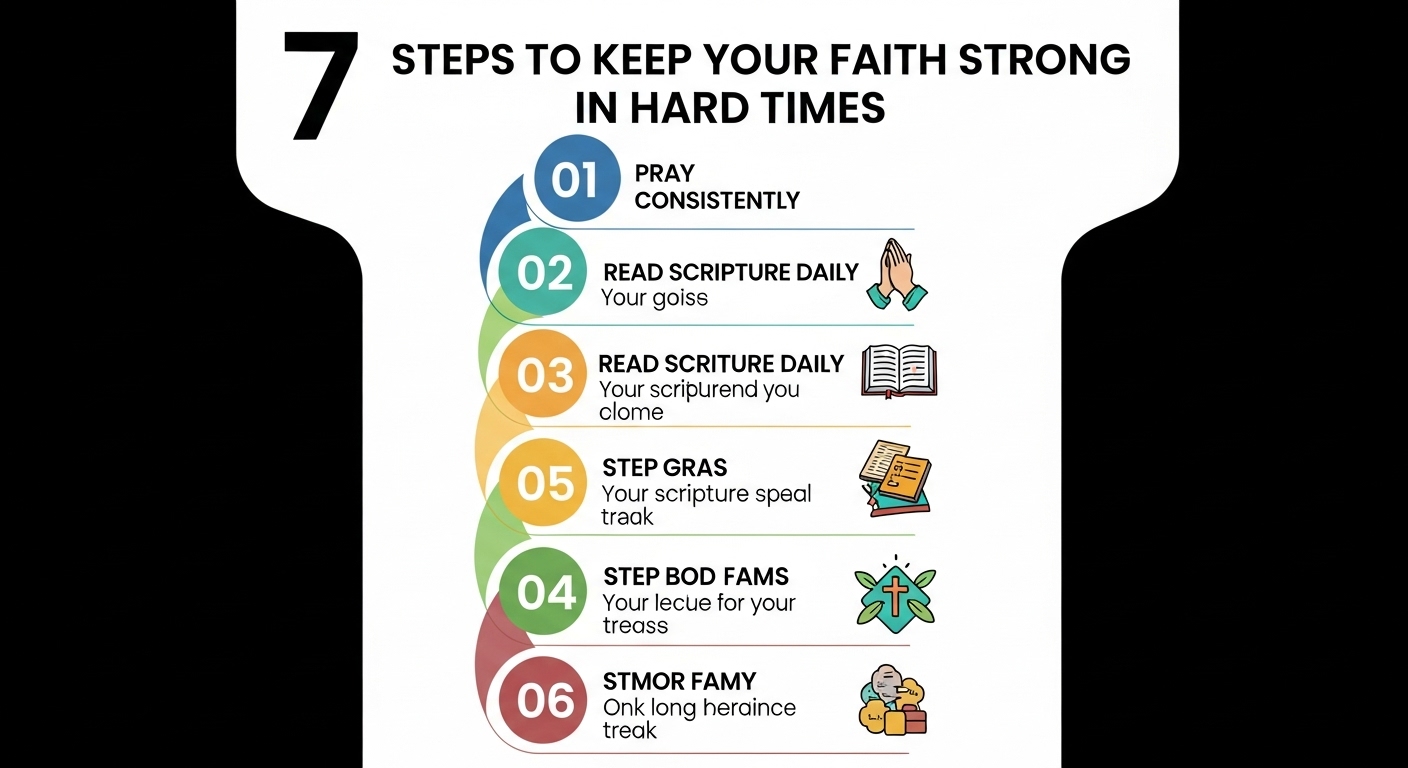
Life is full of ups and downs. Sometimes, we face problems that feel too big to handle. It could be a sickness, losing a job, a broken relationship, or deep sadness. In these hard times, it’s normal to feel lost, scared, or even far from God. Your faith might feel weak, like a small candle in a strong wind.
If this is you right now, please know you are not alone. Every person of faith goes through tough seasons. The good news is that your faith can not only survive these storms but can grow stronger because of them. This article will give you seven clear, practical steps to hold onto your faith when life gets hard.
Why Holding Onto Faith Matters in Difficult Times
Studies show that people with strong spiritual faith often handle stress better. For example, a report from the American Psychological Association notes that faith can provide a sense of meaning, community support, and hope all of which are crucial for mental resilience. Faith isn’t a magic button that removes pain, but it is an anchor that keeps us steady in the storm.
The Bible reminds us in 1 Peter 1:7 that trials test our faith so it may become “genuine and result in praise, glory, and honor.” The goal isn’t to avoid hardship, but to walk through it with God by our side. Let’s explore the seven steps.
Step 1: Be Honest with God (And Yourself)
When pain hits, our first instinct might be to pretend everything is fine. We might think, “A good Christian shouldn’t feel this angry or sad.” This is not true. God can handle your honest feelings.
What to do: Talk to God exactly as you are. Cry out to Him. Tell Him you’re scared, angry, confused, or tired. Look at the Psalms David often cried, “How long, O Lord?” (Psalm 13:1). Being honest is not a sign of weak faith; it’s the first step of real faith. Write your feelings in a prayer journal. Admitting your struggle is how you begin to heal.
Step 2: Remember God’s Past Faithfulness
In the middle of a crisis, it’s easy to forget all the times God has helped you before. Your current problem fills your whole view, like a mountain in front of you.
What to do: Make a “Faithfulness List.” Write down times in your past when God provided, healed, answered a prayer, or carried you through. When fear rises, read this list. The Bible is full of stories where God reminded His people of what He had already done to strengthen them for what was ahead. Remembering builds hope. For powerful examples, you can read other Christian stories of faith that highlight God’s consistent character.
Step 3: Cling to a Specific Promise from Scripture
A worried mind needs truth to hold onto. General belief is good, but a specific promise from God’s Word is a lifeline.
What to do: Find a few Bible verses that speak directly to your fear or need. Write them on index cards. Put them on your mirror, fridge, or phone background. Say them out loud every day. For instance:
- When afraid: “Do not fear, for I am with you” (Isaiah 41:10).
- When worried: “Cast all your anxiety on him because he cares for you” (1 Peter 5:7).
- When feeling weak: “My grace is sufficient for you, for my power is made perfect in weakness” (2 Corinthians 12:9).
For more guidance, our collection of spiritual preparation Bible verses can be a great resource.
Step 4: Stay Connected to Your Community
Hard times tempt us to hide and isolate ourselves. This is when we need other believers the most. Your faith community is part of God’s provision for you.
What to do: Even if you don’t feel like it, reach out. Go to church. Call a trusted friend from your small group. Ask people to pray for you. Let them bring you a meal or just sit with you. Community faith is vital because others can hold up your arms when you are too tired to fight, just as Aaron and Hur held up Moses’ arms in battle (Exodus 17:12). Learn more about why community faith is vital for enduring trials.
Step 5: Choose Praise and Thankfulness
This step is hard, but powerful. Praise is not about thanking God for the bad thing, but thanking God in the middle of it. It shifts your focus from the size of your problem to the greatness of your God.
What to do: Start small. Find one thing to be thankful for each day: a sunrise, a kind word, a warm bed. Listen to worship music that speaks of God’s power and love. As you practice thankfulness, you train your heart to see God’s presence even in the dark. This act of perseverance will, in time, yield a harvest of peace.
Step 6: Take Practical Care of Yourself
Faith lives in our spirit, but it is connected to our body and mind. When we are physically drained or emotionally burnt out, it’s harder to feel spiritually strong.
What to do: Be kind to yourself. Get enough sleep. Eat nourishing food. Take a short walk. See a doctor if you need to. Doing these simple things is not selfish; it’s stewardship. You are caring for the “temple” God gave you (1 Corinthians 6:19-20). A weary body can make for a weary faith.
Step 7: Keep Doing the Next Right Thing
When the future is unclear and the path is dark, don’t try to figure out the whole journey. Just focus on the next step.
What to do: Ask yourself: “What is the next faithful thing I can do today?” It might be making a phone call, washing the dishes, reading one chapter of the Bible, or simply getting out of bed. Faith is often an action. As you obey God in the small, known thing, He will guide you to the next step. This is how we walk by faith, one step at a time.
Putting on the Armor for the Fight
Walking these steps is a daily choice, a spiritual battle. The Bible tells us to be spiritually alert and to put on the full armor of God every day. This armor, described in Ephesians 6, includes the shield of faith to “extinguish all the flaming arrows of the evil one.” To stand firm in hard times, you must be dressed for the fight. For a deeper understanding of this daily protection, read our guide on the armor of God meaning and our companion piece on how to be watchful as a Christian.
The Core of Lasting Faith
Ultimately, keeping your faith is about who you know, not just what you do. It’s about trusting the character of God—His unwavering righteousness and love even when you can’t see His hand at work. Faith is built on the core truth that God is good, He is in control, and His promises are true.
For the Christian, our hope extends beyond this life. Our present sufferings are not worth comparing to the eternal glory ahead. This promise of heaven is our ultimate hope and the reason we don’t need to fear our darkest moments. You can explore this comforting truth further in our article on the promise of heaven and the overview of life after death.
FAQs About Keeping Faith in Hard Times
Q: Is it a sin to doubt or feel angry at God during a trial?
A: No, feeling doubt or anger is not a sin. These are human emotions. The sin would be letting those feelings turn you away from God. Bring those feelings directly to Him, just as you would with a loving parent. He understands and wants to comfort you.
Q: What if I’ve tried praying and reading the Bible, but I still feel nothing?
A: Feelings are fickle and often follow action. Sometimes faith is a choice to trust God’s character despite our feelings. Keep praying and reading even when it feels dry. Faithfulness in the “dry” seasons often leads to deeper growth. Consider talking to a pastor or counselor for additional support.
Q: How long does it take to get through a hard time?
A: There’s no set timeline. Some trials last days, some years. The goal isn’t just to “get through it,” but to allow God to shape you through it. Focus on daily faithfulness rather than the calendar.
Q: How can I help a friend who is losing their faith?
A: Don’t preach. Listen. Be present. Pray for them silently and out loud. Offer practical help. Remind them gently of God’s love, and point them to resources like this one. Sometimes, your steady presence is the greatest testimony of God’s love. We are called to thank God for each other and support one another in the journey.
Q: Will my faith ever be as strong as it was before?
A: It can be stronger. A faith that has been tested and has endured is deeper and more resilient. Like a bone that heals from a break, it can become stronger at the broken place.
Conclusion: You Are Not Alone
Hard times will come. But you have a choice: to let the storm blow you away, or to let it drive your roots deeper into God. These seven steps—being honest, remembering, clinging to Scripture, staying connected, choosing praise, caring for yourself, and taking the next step—are your practical guide.
Start with one step today. Be kind to yourself. And hold onto this truth: The God who allowed this trial is walking through it with you. He will use it to shape you, strengthen you, and reveal His love to you in profound ways. Your faith can survive this. More than that, with God’s help, it can thrive.

0 Comments