

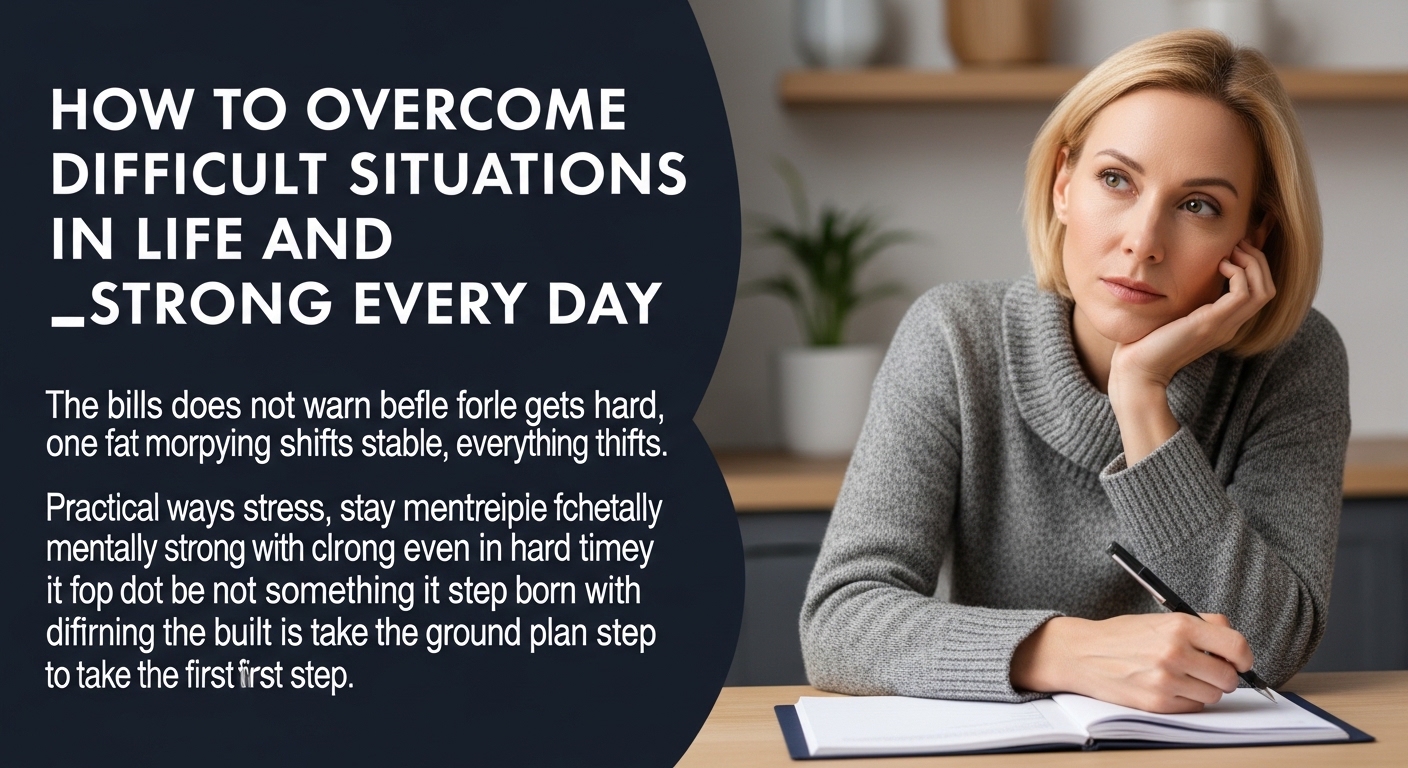
Practical ways to handle stress, stay mentally strong, and move forward with clarity even in hard times
Life does not warn before it gets hard. One moment everything feels stable, and the next, everything shifts. The bills pile up, a relationship ends, a job disappears, or a health scare turns the world upside down. In those moments, it is easy to feel like the ground is falling out from under you.
The good news is this: strength is not something people are born with. It is something built, step by step, during difficult situations in life. You do not have to be a superhero to get through this. You just need a simple plan and the willingness to take the first small step.
Start Building Inner Strength Today
Trusted by psychologists and backed by real-life strategies
Quick Answer: How to Overcome Difficult Situations
Overcoming difficult situations in life starts with controlling what can be controlled, managing your thoughts, and taking small, consistent actions daily. It is not about ignoring the pain; it is about refusing to let the pain control your future.
- Accept the situation without denial. Acknowledging reality is the first step to changing it.
- Focus on what can be controlled. You cannot control the wind, but you can adjust your sails.
- Build emotional resilience. Learn to bend so you don’t break.
- Take small daily actions. Progress, no matter how tiny, creates momentum.
- Stay connected with support systems. You are not meant to carry heavy burdens alone.
Why Do Difficult Situations Happen in Life?
If you are currently facing a hard time, you might be asking, “Why is this happening to me?” It is a natural question. The truth is, difficult situations are a universal part of the human experience.
Life is unpredictable. It involves uncertainty, loss, failure, and constant change. Sometimes these challenges are external like a sudden accident or a financial crisis. Other times, they are internal like battling anxiety, grief, or self-doubt.
However, here is a perspective shift that can change everything: Adversity is often a catalyst for growth. Just as a muscle must be stressed to grow stronger, the human spirit often develops its deepest resilience during times of struggle. You are not being punished; you are being prepared for a stronger version of yourself.
Why Most People Feel Stuck During Hard Times
When hardship hits, the brain goes into survival mode. This is normal, but it often leads to a trap. Understanding why you feel “stuck” is the key to getting unstuck.
The Traps That Hold You Back:
- Overthinking and Fear: Your mind starts playing “worst-case scenario” on repeat. This analysis paralysis prevents you from taking any action.
- Lack of Control: Trying to control other people or the past is like trying to hold water in your hands. It is exhausting and impossible.
- Emotional Exhaustion: Grief, anger, and frustration drain your mental battery. When you are tired, everything feels 10 times harder.
- Negative Thought Loops: You might start telling yourself, “I always fail” or “Nothing ever works out.” Your brain believes what you tell it.
The good news? Once you recognize these traps, you can learn to step out of them.
10 Practical Steps to Overcome Difficult Situations in Life
Here is your roadmap. You do not need to do all of these at once. Pick one, start small, and build from there.
1. Accept Reality Without Resistance
Denial is a normal first reaction, but staying there is dangerous. Acceptance does not mean you like what is happening; it means you stop fighting reality. When you stop saying, “This shouldn’t be happening,” you free up energy to say, “What do I do now?”
2. Focus Only on What You Can Control
Draw a circle. Inside the circle, write what you can control (your effort, your attitude, your actions, your words). Outside the circle, write what you cannot control (other people’s opinions, the past, the weather). Spend 90% of your energy inside the circle.
3. Break Problems Into Smaller Actions
A mountain looks impossible to climb. But a path? That is just one step after another. If a problem feels too big, ask yourself: What is the smallest, easiest step I can take in the next five minutes? Do that.
4. Train Your Mind to Stay Calm
When stress hits, your body reacts. Learn to pause. Take three deep breaths inhale for four seconds, hold for four, exhale for four. This simple act signals your nervous system to calm down, allowing you to think clearly instead of reacting emotionally.
5. Build a Daily Strength Routine
Strength isn’t just for emergencies; it is built daily. This could be a 10-minute walk, writing down one thing you are grateful for, or reading something encouraging. Consistency creates a foundation that holds when storms come.
6. Avoid Negative Inputs and Influences
You are the average of what you consume. If you are constantly watching doom-scrolling on social media or listening to people who tear you down, your mindset will suffer. Protect your mental space like a garden weed out the negativity.
7. Talk to Someone You Trust
Isolation is the enemy of healing. You do not need to fix your problems alone. Find one person—a friend, a family member, a mentor who will listen without judgment. Speaking your fears out loud often makes them seem smaller.
8. Take Care of Physical Health
Your mind lives inside your body. When you are going through a difficult time, your physical health often takes a hit. Prioritize sleep, drink water, and move your body. Even a 10-minute walk can change your brain chemistry and reduce stress hormones.
9. Learn From the Situation
Ask yourself: What is this situation teaching me? Sometimes hardship teaches us who our real friends are. Sometimes it teaches us how strong we actually are. Shifting from “victim” to “student” puts you back in the driver’s seat.
10. Keep Moving Forward, Even Slowly
You do not need to feel motivated to move. Action often comes before motivation. If you can only manage 1% progress today, that is enough. A slow crawl forward is infinitely better than standing still.
Pro Tip: Strength is built through consistency, not intensity. It is better to do one small thing every day than to try to fix everything in one exhausting weekend.
How to Stay Strong Every Day (Simple Daily System)
You don’t need a complicated life overhaul to stay strong. You just need a simple system that anchors you. Try this three-part routine:
Morning Mindset Reset
- Before checking your phone: Take 60 seconds to breathe and set an intention. Say to yourself, “Today, I will handle what comes my way.”
- Ask: What is one thing I can do today that moves me forward?
Midday Awareness Check
- Pause: Around lunchtime, check in with your emotions. Are you tense? Are you doom-scrolling? If your stress is high, step away for 5 minutes to reset.
Evening Reflection
- Gratitude: Write down one thing that went well today, even if it was small.
- Release: Acknowledge what went wrong, then consciously decide to let it go. Worrying about it in bed won’t change it.
Proven Psychological Techniques to Handle Difficult Situations
To boost your resilience, it helps to understand how the mind works. Here are three techniques backed by psychological research that can help you overcome difficult situations.
Cognitive Reframing
This is the practice of changing your perspective. Instead of thinking, “This is a disaster,” you reframe it to, “This is a challenge I can handle.” It doesn’t erase the difficulty, but it changes your response to it.
Emotional Regulation
Emotions are like waves. You cannot stop them from coming, but you can learn to surf them. When a strong emotion hits, name it. Say, “I am feeling anger right now.” Naming the emotion reduces its power over you.
Stress Response Control
Your body reacts to stress with a “fight or flight” response. You can override this by activating the “rest and digest” response. Deep breathing, splashing cold water on your face, or going for a walk are all ways to manually tell your body, “We are safe.”
Real-Life Examples of Overcoming Difficult Situations
Sometimes, reading about others who have walked the same road reminds us that we are not alone.
The Job Loss That Opened a New Door
Maria worked at the same company for 12 years. When she was laid off, she felt her identity crumble. For two weeks, she stayed in bed. Then, she started using the 10-step method. She focused only on what she could control: updating her resume and networking for one hour a day. Six months later, she started a business she had always dreamed of. The job loss wasn’t the end; it was the push she needed.
The Failure That Built Character
David started a business that failed. He lost a lot of money and was embarrassed. Instead of hiding, he accepted the loss, wrote down 10 lessons he learned, and used those lessons in his next venture. Today, he is a mentor for young entrepreneurs, using his failure as his greatest teaching tool.
Mistakes That Make Difficult Situations Worse
When you are hurting, it is easy to make choices that feel good in the moment but hurt you in the long run. Avoid these common pitfalls.
- Ignoring the Problem: Hoping it will go away usually makes it grow. Face it early, while it is small.
- Waiting for Motivation: Motivation is fleeting. If you wait to “feel like it,” you will wait forever. Discipline doing what needs to be done even when you don’t want to—is the real driver.
- Comparing with Others: Looking at someone else’s highlight reel on social media and thinking, “Why are they happy and I’m not?” is a trap. Everyone struggles; you just don’t see it on their profile.
- Avoiding Action: Overthinking is a form of avoidance. Taking imperfect action is always better than taking no action.
How to Build Long-Term Mental and Emotional Strength
Getting through a difficult situation is one thing. Building a life where you can handle anything that comes your way is another.
Discipline Over Motivation
Motivation says, “I’ll work out when I feel like it.” Discipline says, “I work out because it’s Tuesday.” Build habits that support your mental health so you don’t have to think about them when times get tough.
Habit Stacking
Attach a new “strength habit” to something you already do. For example:
- After I brush my teeth (existing habit), I will take three deep breaths (strength habit).
- Before I drink my morning coffee, I will write down one goal for the day.
Identity Shift
Instead of saying, “I am struggling,” start saying, “I am a resilient person who handles challenges.” When your identity shifts, your actions naturally follow.
For more on the foundational principles of grace and forgiveness that help sustain us through trials, you can explore The Heart of the Christian Faith: Forgiveness & Grace .

0 Comments