

Photo by Timon Studler
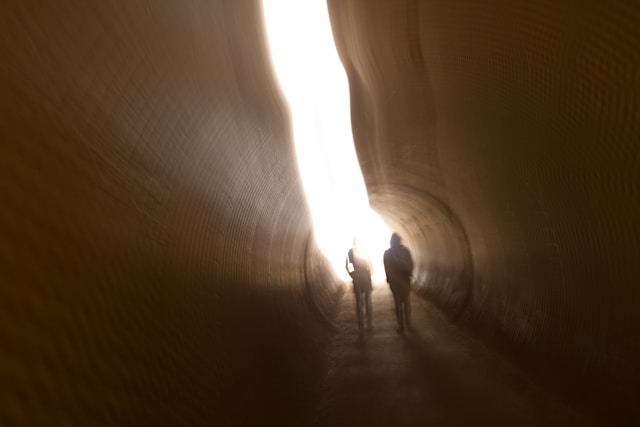
There is no doubt that even a lot of nominal Christians are fascinated by near-death experiences. These are the ones talking about seeing angels and getting encouraging messages from loved ones. All these provide strong evidence of life beyond death. In his Living Life with Blinders On, Dr. Julius Mosley II reflects on that same topic and the role of religion in interpreting near-death experiences. In doing so, he touches on how proper Christian theology of the afterlife is also a deeply personal matter, and that a life after death book should encourage a lived faith in God.
How Faith Shapes Near-Death Accounts
It is really no coincidence that a lot of NDE stories today are told by people who still hold a moderate degree of faith. However, there is a worldly fallacy in thinking such experiences are somehow produced by spiritual belief systems and not the other way around.
They might claim only a Christian might describe meeting Christ or seeing heaven’s gates, while someone from another tradition may report seeing figures or places tied to their faith. While this may prove the role of religion in interpreting near-death, it cannot be taken at face value when the source may still not be that of God.
It is still important to discern spirits (1 John 4:1). And only in that light can it be truly said that one’s NDE is shaped by true faith.
If you’ve had an NDE and saw deceased family members, pay attention to what they say. How many times do they call you to repent? Do they speak truth about false, man-made philosophies taught to you?
If you have had visions of angels or divine beings, then who is it they say is Lord? The idea that religious influence on NDEs can shape what people perceive (rather than the other way around) can still lead to deception. It is only faith in the Lord that creates a filter that transforms such an extraordinary event into something consistent with long-held truths.
In Dr. Mosley’s case, NDEs have raised the question of whether people are ready for eternity. His book stresses the importance of being spiritually prepared, not assuming that life’s end is simply a fade into nothingness. Here, it is not mere religion interpreting the experience but challenging the individual to reflect on judgment, accountability, and hope beyond the grave.
Religion in Interpreting Near-Death Experiences Across Cultures
Photo by Ioann-Mark Kuznietsov
When examining NDEs globally, one should pay attention to the similarities of the Truth while being on guard for the ones with differences.
Some might think there is a cross-cultural NDE analysis where certain elements appear universal—such as tunnels of light, a sense of peace, or leaving the body. They overemphasize that the details often depend on cultural context. For instance, Buddhists might see Bodhisattvas, while Christians may describe meeting Jesus.
These differences are just smoke and mirrors. It is not complicated to see past these and remember John 14:6. Only Christ is the way, and any vision of other things should only be taken as a sign to get right with God.
This is where religion in interpreting near-death proves truly powerful. It highlights the Christian truth about the meaning of life.
All the personal flashes of memory, sights of things beyond, and voices of the spirit ultimately call all souls to be born again. People rarely return from an NDE unchanged. Many speak of renewed faith, a stronger sense of purpose, or a commitment to live differently. These outcomes are all but God Himself calling you to Him, to seek out Christ and confess Him as Lord.
Dr. Mosley’s reflections echo this point. He emphasizes that humanity often ignores the eternal perspective until confronted with mortality. Near-death encounters, therefore, become wake-up calls, forcing us to remove “blinders” and see life in light of eternity. Furthermore, false religion only deceives with earthly languages and symbols. They become less confusing as soon as the NDE experience leads to studying God’s Word, and prompting the rejection of such worldly distractions.
Theological Reflection and Human Truth
Yet even then, many still persist in asking: Is that really the ultimate truth behind these experiences?
These are the ones that cite scientific explanations or obsess about chemicals circulating around due to stress.
That matters little, because the spiritual tradition sees them from the higher truth. And from that higher truth, they get glimpses of eternity.
Theological interpretation of NDEs is not focused on the biological hows and whats. They are about pointing at the more obvious, more poignant realities about what they mean for how we live.
It’s why many believers should never cease to check how NDEs align with scriptural accounts of life after death. Others caution against relying solely on personal experience and develop solid Bible study habits for guidance. For Dr. Mosley, the key issue is not to dismiss or romanticize near-death encounters but to see them as reminders of deeper spiritual realities. They challenge us to ask: Am I prepared? Do I understand what lies beyond? Am I living in a way that acknowledges accountability before God?
It is here that religion, in interpreting near-death, meets human truth. While cultures and faiths offer different stories, such differences should be a sign to measure them against the one Truth in God’s Word. The experiences often lead to humility, gratitude, and a reevaluation of priorities. They remind us that no matter how advanced science becomes, the human heart still seeks meaning beyond physical survival.
What We Can Learn from These Accounts
- NDEs show us how fragile life is and how quickly it can end.
- Faith often gives structure to what would otherwise be confusing or frightening experiences.
- No matter what is seen, it should prompt genuine truth seekers to study God’s Word.
- Religion challenges us to see NDEs not just as psychological events but as windows into eternal truths.
These lessons align with the message of Living Life with Blinders On, which urges readers to confront mortality with open eyes. Rather than ignoring or dismissing NDEs, Dr. Mosley encourages interpreting them with a sense of urgency and reflection.
In the end, exploring religion in interpreting near-death experiences for the sake of appeasing the worldly scientific enterprises completely misses the point.
It is about acknowledging the role faith plays in shaping human perception and guiding us toward deeper questions. NDEs challenge the living to consider eternity and how everything is being laid out so that they find their way to Christ. Whether through scripture, testimony, or reflection, these accounts remind us that life is not merely about the present moment but about preparing for what comes next. That truth, both deeply personal and profoundly universal, continues to inspire believers and seekers alike.
If you’d like to learn more about Dr. Mosley’s own NDEs, simply read his testimony in Living Life with Blinders On. Copies are already available on Amazon and ReadersMagnet.

0 Comments